
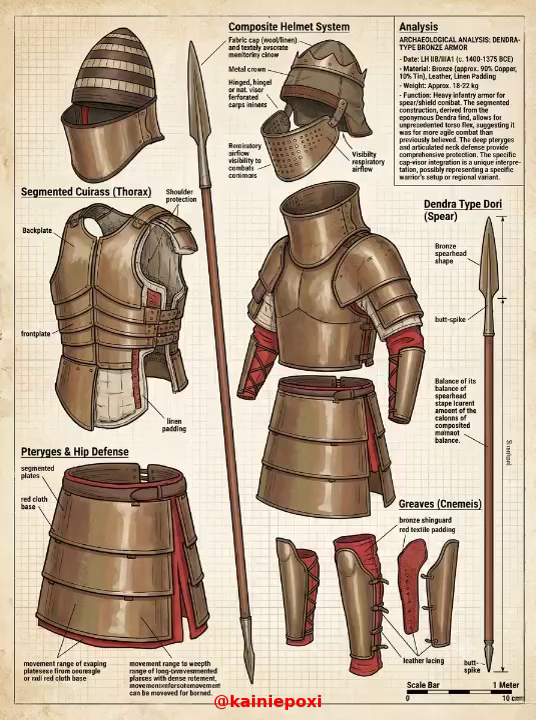
The Dendra Armor is one of the most significant discoveries in the study of Mycenaean warfare and metallurgy.
It was first unearthed in 1926 by a Swedish archaeological expedition in the village of Dendra, near the ancient site of Midea in Argolis, Greece. This armor, made from hammered bronze, dates back to the late 15th century BC, making it one of the oldest known examples of full-body protective gear from the Late Bronze Age.
Its remarkable state of preservation and sophisticated design provide invaluable insights into Mycenaean military technology and combat strategies.
Reevaluating the Armor’s Functionality
In an effort to better understand the practicality of this ancient armor, researchers from the University of Thessaly conducted an experimental study to assess its effectiveness in real combat scenarios.
A highly detailed and historically accurate replica was created by archaeologist Diana Wardle, ensuring that every aspect of the armor, from its materials to its construction methods, closely resembled the original.
To put the aDendra armor to the test, the research team enlisted Greek marines, who were tasked with wearing it while performing a series of military exercises and simulated battle conditions.
Over the course of an 11-hour combat simulation, the participants engaged in various maneuvers, including marching, running, and engaging in mock battles, all while adhering to techniques believed to have been used by Mycenaean warriors.
Key Findings: Strength, Mobility, and Strategic Advantages
The results of the study were striking. Contrary to earlier theories suggesting that the armor was too rigid and cumbersome for effective combat, the Greek marines reported that it provided a high level of protection while still allowing significant mobility.
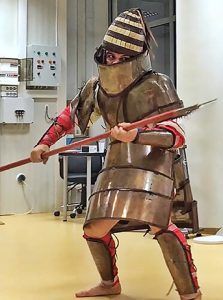
The bronze plates, though sturdy, were designed to distribute weight efficiently, preventing excessive strain on the wearer. The segmented construction allowed for a surprising degree of flexibility, making it possible to execute both defensive and offensive movements with ease.
In addition to its physical advantages, the armor would have likely given Mycenaean warriors a psychological edge over their adversaries.
Its imposing full-body coverage, combined with the gleaming bronze surface, would have made the wearer appear formidable on the battlefield.
A Legacy Preserved in Myth and History
For scholars, the Dendra Armor stands as a testament to the advanced craftsmanship and military expertise of the Mycenaean civilization. It offers a glimpse into the technologies and strategies that enabled Mycenaean warriors to dominate the Aegean and beyond, influencing Greek military traditions for centuries. T
his legacy is echoed in Homeric epics such as the Iliad, where the armor of great warriors is described in vivid detail, reflecting the prestige and importance of such protective gear in Mycenaean culture.
Today, the original Dendra Armor is housed in the Archaeological Museum of Nafplio, where it continues to fascinate historians, archaeologists, and visitors alike, serving as a bridge between the past and our modern understanding of ancient warfare.