
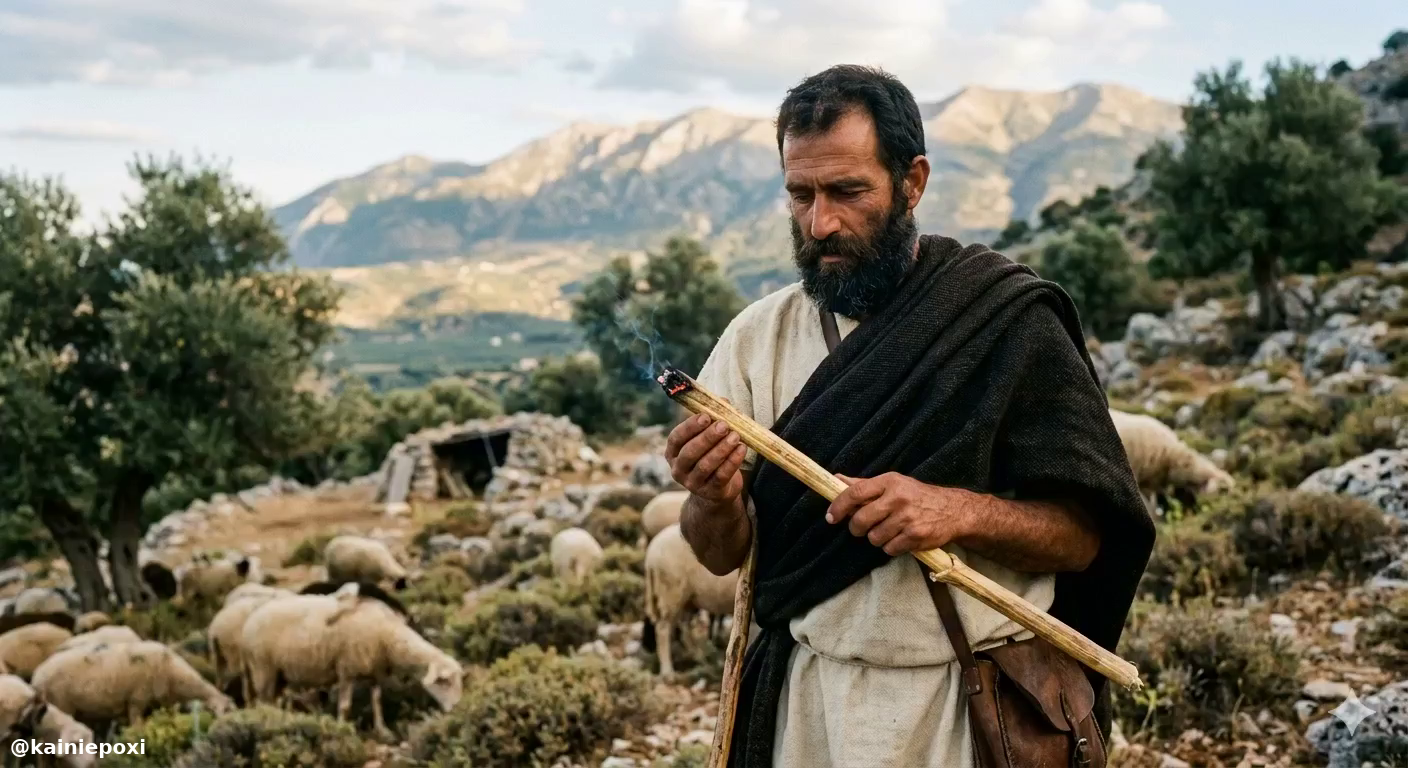
In the sun-drenched, rugged highlands of ancient Greece, a shepherd’s life was defined by isolation and the elements. Whether in the Pindus Mountains or the rocky terrain of Arcadia, a fire was more than a luxury—it was a lifeline for warmth, protection against wolves, and the preparation of food. While we often think of flint and steel, the Greeks had a more sophisticated, «living» method for carrying fire over long distances: the Narthex.
The Legend and the Botany
The technique of the narthex finds its roots in the most famous fire story of all time. According to Hesiod’s Theogony, when Prometheus stole fire from Mount Olympus to give to humanity, he didn’t use a torch or a bucket. He hid the spark inside a hollowed-out stalk of giant fennel (Ferula communis).
The Fire-Stealer’s Secret: The Ancient Greek «Narthex» Technique
In the sun-drenched, rugged highlands of ancient Greece, a shepherd’s life was defined by isolation and the elements. Whether in the Pindus Mountains or the rocky terrain of Arcadia, a fire was more than a luxury—it was a lifeline for warmth, protection against wolves, and the preparation of food. While we often think of flint and steel, the Greeks had a more sophisticated, «living» method for carrying fire over long distances: the Narthex.
The Legend and the Botany
The technique finds its roots in the most famous fire story of all time. According to Hesiod’s Theogony, when Prometheus stole fire from Mount Olympus to give to humanity, he didn’t use a torch or a bucket. He hid the spark inside a hollowed-out stalk of giant fennel (Ferula communis).
This wasn’t just poetic license; it was a reflection of a common shepherd’s practice. The giant fennel, or narthex, is a plant that grows abundantly across the Mediterranean. It has a unique botanical structure:
The Exterior: A tough, green rind that is surprisingly fire-resistant.
The Interior: A dry, spongy, pithy core that burns incredibly slowly.
How the Technique Worked
Ancient shepherds and travelers would harvest the tall, dried stalks of the fennel. By igniting one end of the internal pith, the fire would «smolder» rather than ignite into a flame.
The Ember: A small coal or spark was placed against the pith at the top of the stalk.
The Insulation: Because the outer rind limited the oxygen flow, the pith would burn at a microscopic pace—effectively acting as a biological «slow-burning fuse.»
The Transport: A shepherd could walk for hours, or even a full day, with the fire tucked under his arm or tied to his pack. Upon reaching a new camp, he would simply blow on the glowing pith or tap it out into a bed of dry tinder to start a fresh blaze.
Is it Applicable Today?
In a world of butane lighters and ferrocerium rods, the narthex technique is rarely «necessary,» but it remains highly applicable for bushcraft enthusiasts and survivalists.
Sustainability: It is a 100% biodegradable way to transport fire without using chemical fuels.
Efficiency: For those practicing «primitive» skills, starting a fire from scratch with a hand-drill or bow-drill is exhausting. The fennel stalk allows you to start a fire once and «carry» it with you as you move through the wilderness.
Modern Safety Note: While effective, Ferula communis can be toxic if ingested by livestock (causing «ferulism»), and one must ensure the stalk is completely extinguished before discarding it to prevent wildfires.
The Fire-Stealer’s Secret: The Ancient Greek «Narthex» Technique
In the sun-drenched, rugged highlands of ancient Greece, a shepherd’s life was defined by isolation and the elements. Whether in the Pindus Mountains or the rocky terrain of Arcadia, a fire was more than a luxury—it was a lifeline for warmth, protection against wolves, and the preparation of food. While we often think of flint and steel, the Greeks had a more sophisticated, «living» method for carrying fire over long distances: the Narthex.
The Legend and the Botany
The technique finds its roots in the most famous fire story of all time. According to Hesiod’s Theogony, when Prometheus stole fire from Mount Olympus to give to humanity, he didn’t use a torch or a bucket. He hid the spark inside a hollowed-out stalk of giant fennel (Ferula communis).
This wasn’t just poetic license; it was a reflection of a common shepherd’s practice. The giant fennel, or narthex, is a plant that grows abundantly across the Mediterranean. It has a unique botanical structure:
The Exterior: A tough, green rind that is surprisingly fire-resistant.
The Interior: A dry, spongy, pithy core that burns incredibly slowly.
How the Technique Worked
Ancient shepherds and travelers would harvest the tall, dried stalks of the fennel. By igniting one end of the internal pith, the fire would «smolder» rather than ignite into a flame.
The Ember: A small coal or spark was placed against the pith at the top of the stalk.
The Insulation: Because the outer rind limited the oxygen flow, the pith would burn at a microscopic pace—effectively acting as a biological «slow-burning fuse.»
The Transport: A shepherd could walk for hours, or even a full day, with the fire tucked under his arm or tied to his pack. Upon reaching a new camp, he would simply blow on the glowing pith or tap it out into a bed of dry tinder to start a fresh blaze.
Is it Applicable Today?
In a world of butane lighters and ferrocerium rods, the narthex technique is rarely «necessary,» but it remains highly applicable for bushcraft enthusiasts and survivalists.
Sustainability: It is a 100% biodegradable way to transport fire without using chemical fuels.
Efficiency: For those practicing «primitive» skills, starting a fire from scratch with a hand-drill or bow-drill is exhausting. The fennel stalk allows you to start a fire once and «carry» it with you as you move through the wilderness.
Modern Safety Note: While effective, Ferula communis can be toxic if ingested by livestock (causing «ferulism»), and one must ensure the stalk is completely extinguished before discarding it to prevent wildfires.
Historical Evidence and Bibliography
The use of the fennel stalk is well-documented, bridging the gap between mythological symbolism and practical agricultural reality.
Primary Sources:
Hesiod, Theogony (c. 700 BCE): «He [Prometheus] fooled him [Zeus] and stole the far-seen gleam of unwearying fire in a hollow fennel stalk.»
Theophrastus, Enquiry into Plants (c. 300 BCE): The «father of botany» describes the narthex in detail, noting its internal pith and its use in carrying fire and making walking sticks.
Pliny the Elder, Natural History (77 CE): In Book XIII, Pliny discusses the Mediterranean flora and confirms the fennel’s use for fire-carrying, noting that it provides excellent tinder.
Secondary Scholarly References:
Mayor, A. (2011). The First Fossil Hunters: Paleontology in Greek and Roman Times. Princeton University Press. (Discusses the practical uses of local flora in ancient life).
Baumann, H. (1993). The Greek Plant World in Myth, Art, and Literature. Timber Press. (Specifically analyzes the link between the Ferula genus and the Prometheus myth).
West, M. L. (1966). Hesiod: Theogony. Oxford University Press. (Critical commentary on the cultural significance of the narthex).