
Today, the word “parasite” usually describes an organism that lives off another living being, or metaphorically, a person who exploits others for personal gain. Yet the word has surprisingly honorable and social origins in the world of ancient Greece.
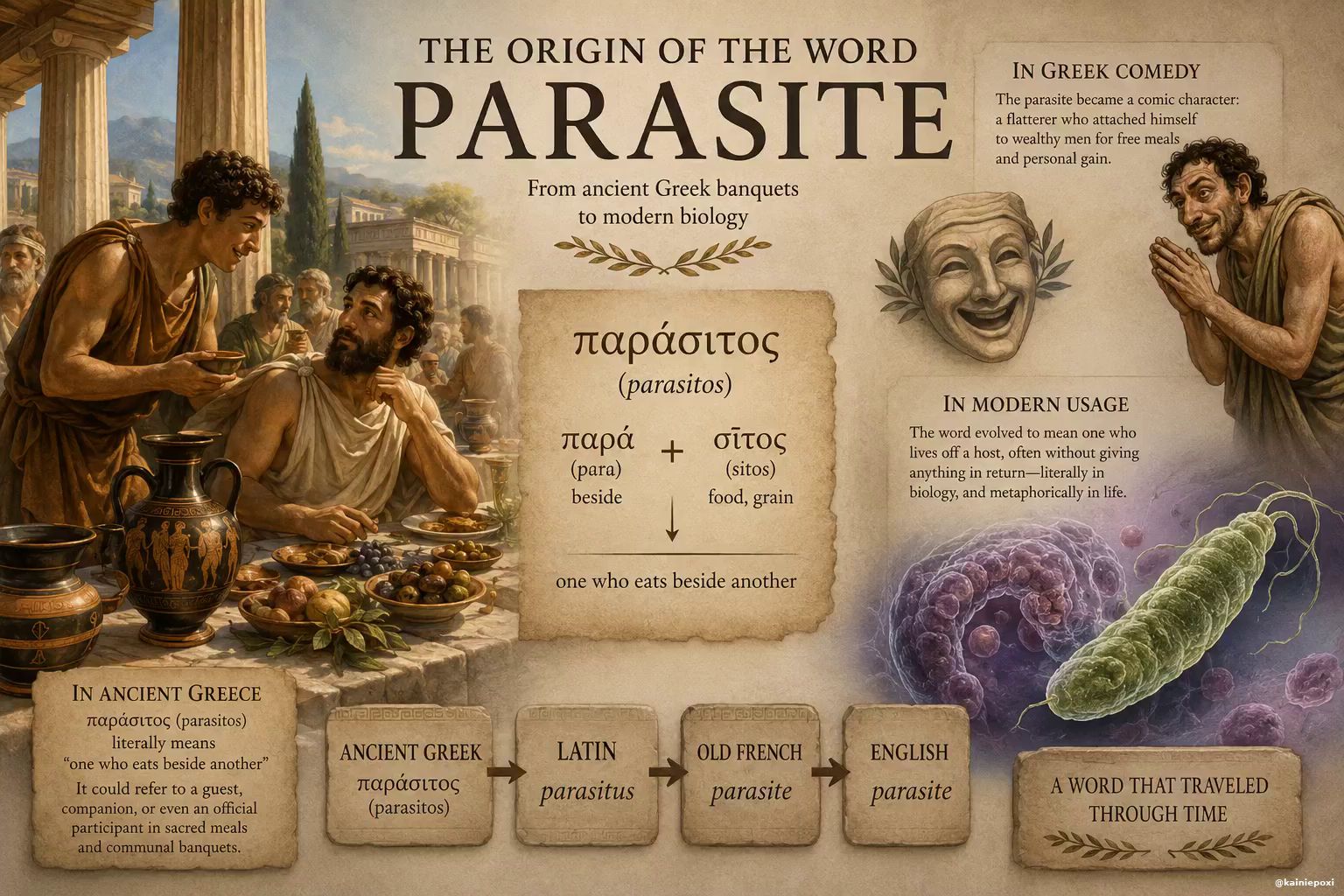
The English word “parasite” comes from the Latin word parasitus, which in turn comes from the ancient Greek word παράσιτος (parasitos).
The linguistic chain is:
Ancient Greek παράσιτος (parasitos) → Latin parasitus → Old French parasite → English parasite
The original Greek word is formed from:
- παρά (para) = beside, alongside
- σίτος (sitos) = food, grain, bread
So the original meaning was literally:
“one who eats beside another”
or
“table companion.”
In early ancient Greek society, a parasitos was not necessarily viewed negatively. In fact, the role could even be official or religious.
Certain individuals known as parasitoi participated in sacred or public meals connected with temples, sacrifices, or civic institutions. These people were granted the privilege of dining alongside priests, magistrates, or honored citizens. In some city-states, the position was institutionalized and tied to religious ceremonies.
Communal dining was extremely important in Greek culture. Shared meals symbolized social bonds, political unity, and religious participation. Therefore, eating “beside” someone carried a deeper meaning of inclusion and status.
From Sacred Guest to Comic Freeloader
Over time, however, the meaning of the word began to shift.
In Greek comedy — especially in the works of Menander and later Hellenistic writers — the parasitos became a recognizable comic character: a flatterer who attached himself to wealthy men in order to secure free meals.
This literary stereotype transformed the word’s reputation. The parasite was now portrayed as:
- a sycophant,
- a professional dinner guest,
- a manipulator surviving through charm and opportunism.
The comic image proved powerful enough that the negative meaning gradually replaced the older ceremonial one.
The Journey Into Modern Languages
The Greek word passed into Latin as parasitus, and from there entered many European languages:
- English: parasite
- French: parasite
- Italian: parassita
- Spanish: parásito
By the scientific era, the term was adopted in biology to describe organisms that live off hosts while giving little or nothing in return. The metaphor from social behavior to natural behavior became permanent.
A Word That Preserves Ancient Society
The evolution of the word “parasite” reveals something fascinating about language and culture. A term that once referred simply to “someone dining beside another” slowly transformed into one associated with exploitation and dependency.
It also reflects the importance of communal meals in ancient Greek civilization, where eating together was tied to religion, politics, hierarchy, and friendship.
In a sense, every time the modern word “parasite” is spoken, it still carries a hidden memory of the ancient Greek banquet table.
Bibliography:
Ancient Sources
- Deipnosophistae — Atheneus
A major source on ancient Greek banquets, dining customs, and the social role of the parasitos. - Dyskolos — Menander
Illustrates social archetypes and comic figures associated with opportunistic dining culture. - Knights — Aristophanes
Useful for understanding satire, flattery, and social dependency in Athenian comedy. - Moralia — Plutarch
Contains discussions on table manners, social behavior, and communal dining.
Modern Scholarly Works
- Baldwin, Barry. The Parasite in Greek Comedy.
A focused study on the literary and social development of the “parasite” character in ancient Greek theater. - Davidson, James. Courtesans and Fishcakes: The Consuming Passions of Classical Athens.
Explores food culture, banquets, social hierarchy, and pleasure in classical Athens. - Garnsey, Peter. Food and Society in Classical Antiquity.
A broader academic examination of food, communal meals, and social structures in the ancient Mediterranean. - Wilkins, John & Shaun Hill. Food in the Ancient World.
Discusses the cultural significance of dining and the symbolism of shared meals in Greek society. - Oxford English Dictionary, entry: “Parasite.”
Provides the etymological evolution from Greek parasitos to the modern English term. - Liddell, Henry George & Robert Scott. A Greek-English Lexicon (LSJ).
Standard reference work for ancient Greek vocabulary and meanings, including παράσιτος (parasitos).