
In the study of classical antiquity, the visual landscape is frequently dominated by the pristine white drapery of the elite—the sweeping lines of the himation worn by philosophers or the structured, elegant folds of the high-status peplos.
However, the operational engine of the wealthy Greek household (the oikos) relied entirely on a disenfranchised class of domestic laborers and enslaved persons. To fully reconstruct the societal reality of ancient Greece, one must look closely at the utilitarian garments designed explicitly for labor, mobility, and immediate social categorization.
The social semiotics of slaves’ dress
In ancient Athens, dress served as an explicit marker of legal and economic status, yet historical sources reveal a fascinating paradox. Pseudo-Xenophon, in the Constitution of the Athenians (1.10), famously complains that one could not easily distinguish an Athenian slave from a free citizen on the streets of Athens by appearance alone, because citizens did not dress sumptuously, and slaves were not forced to wear distinctive clothing clothes by law.
However, within the walls of a wealthy estate, the functional reality of domestic work dictated a strictly utilitarian wardrobe. The clothes of a servant were defined by cheap, durable materials, coarse weaving, and structural modifications designed to prevent physical restriction during labor. While an elite citizen’s dress emphasized leisure through long, voluminous swathes of fine linen or imported wool, the servant’s dress prioritized economy and motion.
Historical Source Insight «If you stroke an Athenian slave, he will not turn around, for the populace there is no better dressed than the slaves or metics, nor are they any better in appearance.» — Pseudo-Xenophon, Constitution of the Athenians (Old Oligarch)
Piece-by-piece material breakdown
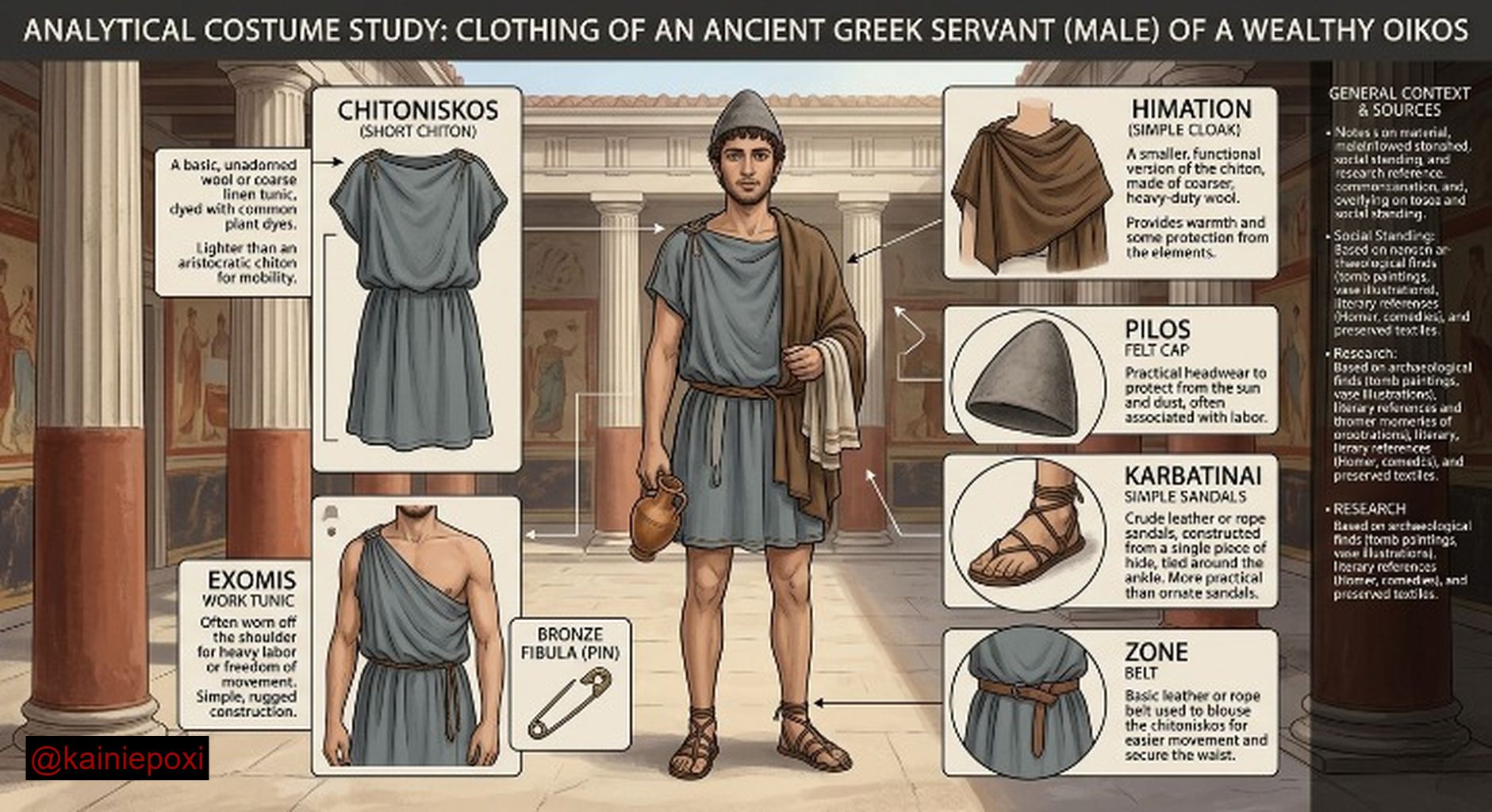
Based on surviving Attic red-figure pottery iconography, funeral stele reliefs, and literary inventories, the typical dress assembly of an elite household’s servant consisted of the following sequential layers and accessories:
| Garment & Class | Material & Construction | Functional & Historical Context |
The Exomis
(ἐξωμίς) | Coarse, heavy wool or low-grade unbleached linen. Left un-dyed, retaining a dull off-white, beige, or earthy brown hue. | The quintessential short tunic of the working class. It was fastened over the left shoulder only, leaving the right shoulder, arm, and chest completely bare. This allowed maximum range of movement for manual labor such as drawing water, grinding grain, or lifting heavy furniture. |
The Zone / Girdle
(ζώνη) | Narrow strip of raw leather, cord, or coarse twisted fabric scrap. | Worn tightly around the waist, the belt allowed the wearer to pull excess fabric upward, creating a pouch (kolpos) to store small tools while shortening the hemline well above the knees to keep it free from grime and grease. |
The Pilos Cap
(πίλος) | Molded, thick sheep’s wool felt or occasionally animal hide. | A brimless, conical skullcap worn primarily by laborers, artisans, and sailors. For a household servant, it protected the hair from dust, soot from olive oil lamps, and hearth embers, while signifying low status. |
Simple Sandals or Carbatinae
(καρβατίναι) | Undressed ox-hide soles secured by rudimentary leather thongs. | While domestic servants frequently worked barefoot indoors to preserve the mosaic or packed-earth floors of the master’s house, outdoor errands required basic footwear. The carbatina was made from a single piece of rawhide stitched together at the heel and laced over the foot. |
Gendered variables in servile Dress
While the male servant or field hand predominantly wore the exomis, female domestic servants within the wealthy oikos—such as nurses, weavers, and ladies’ maids—wore a modified version of the chiton. Known in modern scholarship as the «servant chiton,» it featured sleeves that were either cut short or pinned closely to the arms to avoid catching fire during hearth cooking or getting tangled in looms.
Furthermore, visual narratives on classical grave markers often depict female servants with distinct short-cropped hair, a striking contrast to the long, elaborately coiffed locks of free noblewomen. When working, these women covered their shorn heads with a plain fabric wrap or a functional snood (sakkos), signaling total subservience and domestic dedication.
Conclusion
The clothing of the ancient Greek servant was an uncompromising exercise in functional pragmatism. Stripped of the superfluous fabric yards, vibrant saffron or purple dyes, and ornate jewelry that characterized their masters, these individuals wore their occupation on their bodies. The asymmetry of the exomis, the roughness of unbleached wool, and the plain geometry of the felt pilos combined to form a visual vocabulary that broadcasted a single, undeniable reality: a life defined by physical labor.